
For developer relations
Publish a release support roadmap
Bug-fix windows, security-only tails, end-of-life dates and deprecations for every version line, in one embeddable chart.
6 min read
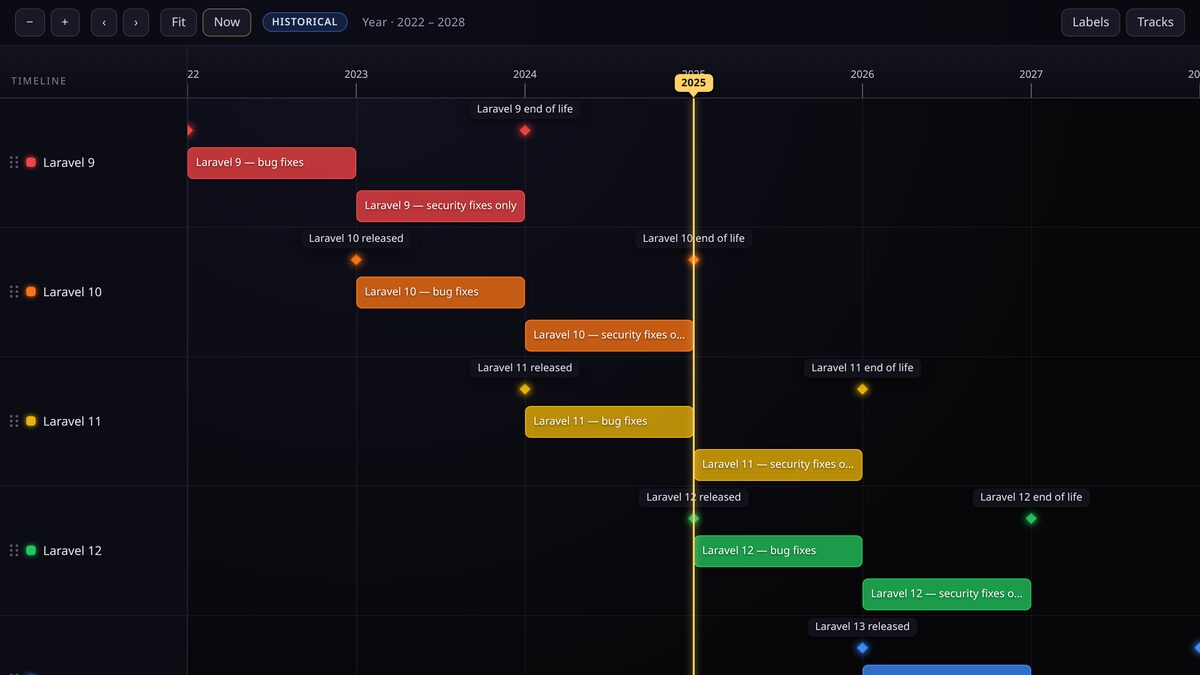
A support policy is a timeline whether you draw it or not. Making it explicit stops the "is this version still supported?" question, and the same format works for any framework, SDK or platform.
A track per version line
Give each major or minor version its own track, ordered newest at the top. Tags keep the lines tidy when a release train has many branches.
Model the phases as ranges
Each support phase is a bounded block of time, so it is a range at day or month precision.
- Active support, range from release to the end of active fixes.
- Security-only support, range for the tail where only security patches land.
- End of life, a point event on the day support ends.
- Long-term support, a range with an extended end date, one track per LTS line.
Deprecations are point events
A deprecation is a moment, not a span. Add it as a point event on each affected line and link the migration guide as a source, so developers land on the upgrade notes from the chart itself.
Use importance to mark breaking changes. A single glance then separates a housekeeping deprecation from a remove-it-now break.
Keep it current
Roadmaps drift. Because the JSON export is re-importable and the MCP server exposes write tools, you can keep the source in a repo and sync the published timeline from a script or an agent whenever a support date changes.
Embed it in your docs
Publish the timeline and embed it in your documentation or release-notes page. It updates without a redesign, and every line links back to your migration guides.
Embed snippet
<iframe src="https://timestrands.com/t/laravel-release-roadmap/embed" style="width:100%;height:520px;border:0" loading="lazy" title="Release support roadmap"></iframe>Keep reading
For product managers
Compare product releases side by side
Put iPhone, Pixel and Galaxy launches on one competitive timeline, then swap in your own roadmap or changelog.
Start here
How TimeStrands works
The one-page tour: what tracks, events and sources are, how deep time is stored, and the path from a blank canvas to an embed.